用对"频率"与"全程",让你的时间表达瞬间地道
(本文解决:中文母语者把"一直"统统翻译成 always / all the time,分不清"经常发生"和"从头到尾"的表达瓶颈)
在日常口语和英语写作中,你是不是也经常把 all the time 和 the whole time 混着用?用错了,轻则让人觉得表达不够自然,重则直接造成信息误解。今天我们用最接地气的方式,彻底搞定这对看似双胞胎、实则大不同的"时间表达"。
你是不是也有这些困惑:all the time 和 the whole time 有什么区别?"一直"用英语怎么说?"全程"用英语怎么说?"从头到尾"用英语怎么说?"这几天我一直很想你"能用 always 吗?如果你正在寻找 always / often 的地道替换表达,这篇就是你的答案。
✍️ 本文由 Aice 英语学习团队编写 · 上海氦铂网络科技有限公司 · 2026-11-08 · 适合 CEFR B1–B2 水平学习者
🎯 核心知识点拆解:频率 vs. 全程
要把这两个短语分清楚,其实只需记住两个关键词:"频率" 和 "全程"。
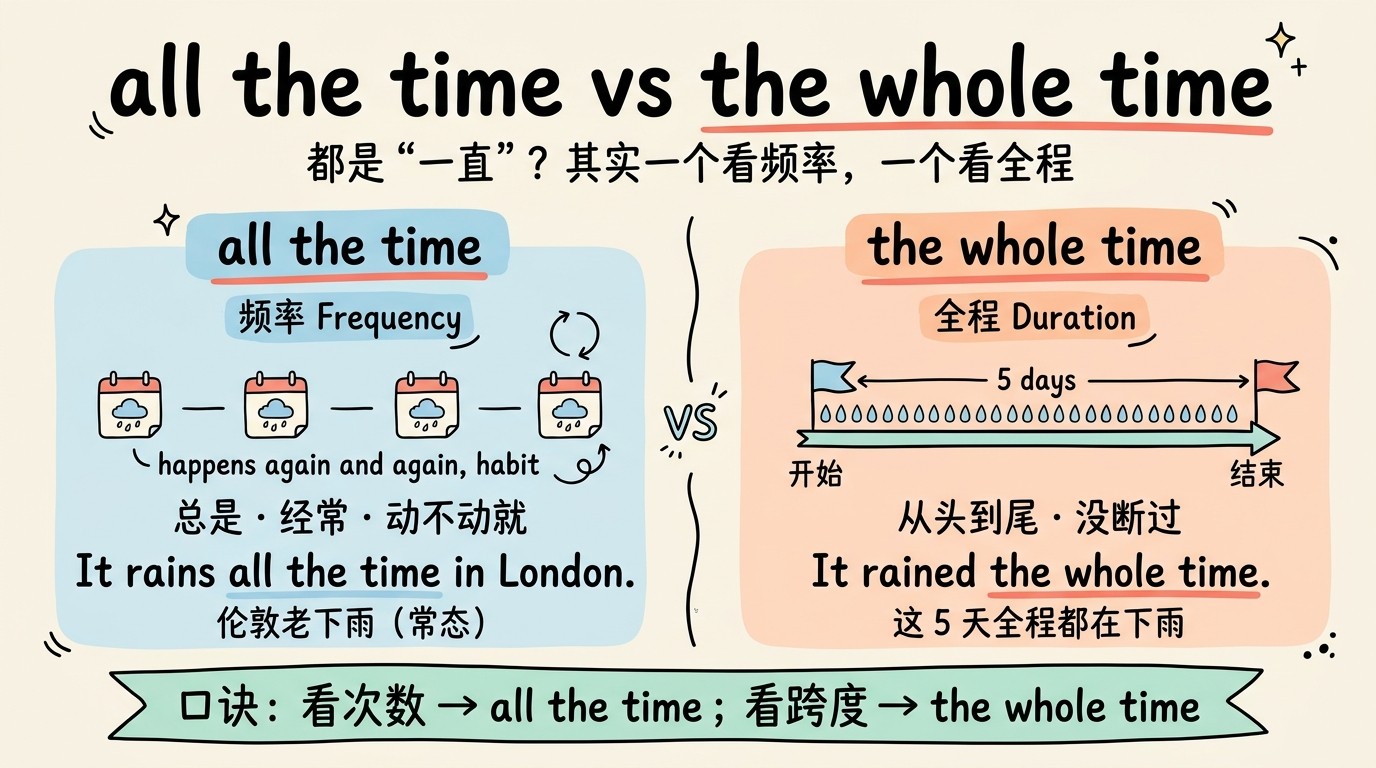
1. All the time 🔁
🔑 频率:总是、经常、动不动就用来描述"规律、习惯与反复发生的动作"。当一件事发生得非常频繁,甚至成为习惯、常态时使用,强调"发生了很多次",等同于 always 或 very often。
🌰 I lose my keys all the time.
我老是丢钥匙。(强调丢钥匙发生了无数次,是个坏习惯。)
🌰 Don't worry, this happens all the time.
别担心,这种事经常发生。(宽慰别人:这是家常便饭。)
🌰 I watch Netflix all the time.
我经常看 Netflix。(这是我的日常娱乐习惯。)
2. The whole time ⏳
🔑 全程:从头到尾、整个过程没断过用来描述"单一事件或某段特定时间的完整过程"。当镜头对准某一件具体的事、某一个特定时间段,强调从开始到结束中途没有停过,就必须用 the whole time,强调"时间跨度的完整性"。
🌰 I was looking for my keys for 20 minutes, but they were in my bag the whole time!
我找了20分钟钥匙,结果它自始至终都在我包里!(这20分钟里,钥匙每一秒都在包里。)
🌰 When I was in Greece, it rained the whole time.
我在希腊度假那阵子,从头到尾都在下雨。(指旅行的那几天,雨几乎没停过。)
🌰 I watched Netflix the whole time that I was sick.
我生病的那几天,全程都在刷 Netflix。(特定时间段:生病期间;动作:从头刷到尾。)
💡 终极同框对比:一秒理清思路
场景:伦敦的天气
伦敦老下雨,一年四季总下。
我们在伦敦呆了5天,这5天全程都在下雨。
🎬 想看更直观的视频讲解?点击观看 all the time vs the whole time 教学视频:
📺 视频讲解:频率 vs 全程💡 避坑指南(Chinglish Mistakes to Avoid)
警惕中式思维的直译陷阱!想表达"这几天我一直很想你",很多同学脱口而出:
❌ "I always miss you these days."
母语者听起来会觉得怪异。因为"这几天"是一个特定阶段,应该用持续状态:
✅ "I've been missing you this whole time."
✅ "You've been on my mind the whole time."
🗣️ 发音密码(Connected Speech)
吞音与连读技巧,让你说得像 Native Speaker:
All the time 读作 /ɔːl-ðə-taɪm/
All 结尾是舌尖抵住上齿龈的 Dark L,与后面的 the (/ð/) 衔接时舌尖顺势送出,不要把两个词硬生生切断。
The whole time 读作 /hoʊl-taɪm/
注意 whole 的发音,切忌发成带有重爆破音的 "hold"!它只是一个饱满的双元音后带 Dark L。
🔥 进阶词汇库:6个地道高阶表达
想让你的表达跳出"小白词汇圈"?这6个与"习惯"和"时间持续"相关的表达,立刻收进你的口语素材库:
🏆 黄金实战公式(Bonus!)
想要在雅思口语(Part 2 经历描述)或日常 Small Talk 中讲出层次分明的高分故事?掌握这个叙事黄金结构:
适用场景:描述一次充满波折的旅行、一次紧急的加班,或者一件让人哭笑不得的生活意外。
🌟 示范回答
"Last month, I had to fly to Tokyo for an urgent business conference. Honestly, the flight was an absolute nightmare because the baby sitting right behind me was crying the whole time without a break. I couldn't get a wink of sleep throughout the four-hour journey.
The funny thing is, I travel for work all the time, but this was definitely one of the most exhausting trips I've ever had. Ever since then, I make sure to pack my noise-canceling headphones out of habit."
📝 中文翻译:"上个月,我因为一个紧急商务会议必须飞去东京。老实说,那趟航班简直是场噩梦——坐在我正后方的婴儿全程都在哭闹,一刻都没消停。在整整四个小时的飞行中,我连眼皮都没能合一下。搞笑的是,我虽然经常出差,但这绝对是我经历过最筋疲力尽的一次旅行。从那之后,只要出门,我都习惯性地把降噪耳机塞进包里。"
💡 公式解析:
· 前半段聚焦单一事件:用 the whole time 强调那4个小时没有间断的痛苦体验,瞬间将听众拉入具体情境。
· 后半段回归生活常态:用 all the time 对比自己平时的出差频率,形成反差感,最后用地道短语 out of habit 收尾,逻辑丝滑,地道自然!
🧩 来个小测试,看看你掌握了没有
"我老是忘记带伞。"哪种说法最自然?
A. "I forget my umbrella all the time." B. "I forget my umbrella the whole time."
✅ 答案:A — all the time。忘带伞是反复发生的习惯,强调频率。
"我们在海边那三天,天气全程都很好。"应该填哪个?
"The weather was beautiful ______ during our three days at the beach."
A. all the time B. the whole time
✅ 答案:B — the whole time。"那三天"是特定时间段,强调从头到尾没变过。
"这几天我一直很想你。"哪种说法更地道?
A. "I always miss you these days." B. "I've been missing you this whole time."
✅ 答案:B — "I've been missing you this whole time.""这几天"是特定阶段,要用持续状态表达全程。
想用书面语或高分口语说"在整场面试中她始终保持镇定",哪个词最合适?
A. all the time B. throughout C. out of habit
✅ 答案:B — throughout。它是 the whole time 的高级书面替代,后面直接接事件。
✨ 简单小结
| 表达/词汇 | 意思 | 语感/场景 |
|---|---|---|
| all the time | 总是,经常,动不动就 | 频率:习惯/常态/反复发生 |
| the whole time | 从头到尾,全程 | 跨度:特定事件/时间段 |
| day in, day out | 日复一日 | ≈ all the time,枯燥持续的常态 |
| on a regular basis | 定期地,经常地 | ≈ often,雅思/职场更正式 |
| non-stop | 不停歇地 | ≈ the whole time,连轴转 |
| throughout | 自始至终 | ≈ the whole time,书面/高分口语 |
| out of habit | 出于习惯 | 解释 all the time 的下意识行为 |
| without a break | 连续地,没有休息地 | 强调高强度、无间断 |
记住口诀:all the time 看频率,the whole time 看全程。下次开口前先问自己:我在说"经常发生",还是"这段时间从头到尾"?💪
对于中文母语的英语学习者,"一直"一词的多种英文对应是最典型的直译陷阱。all the time 对应习惯与常态,the whole time 对应单一事件或特定时间段的完整过程;配合 throughout、non-stop、out of habit 等地道表达,再套用"特定事件 + 全过程 + 日常总结"的叙事公式,口语和写作都能立刻升级。
常见问题解答
Q: all the time 和 the whole time 有什么区别?
一句话答案:all the time 表示频率(总是、经常),the whole time 表示全程(从头到尾没断过)。例如:It rains all the time in London.(伦敦老下雨。)We were in London for five days and it rained the whole time.(那5天全程都在下雨。)
Q: all the time 是什么意思?
一句话答案:all the time 意为"总是、经常、动不动就",描述习惯和反复发生的动作,等同于 always 或 very often。例如:I lose my keys all the time.(我老是丢钥匙。)
Q: the whole time 是什么意思?
一句话答案:the whole time 意为"从头到尾、全程",用于某件具体的事或特定时间段,强调中途没有停过。例如:When I was in Greece, it rained the whole time.(我在希腊那阵子从头到尾都在下雨。)
Q: "一直"用英语怎么说?
一句话答案:看语境。表示习惯、反复发生用 always / all the time;表示特定时间段内从头到尾没断过用 the whole time / throughout / non-stop。
Q: "这几天我一直很想你"能说 I always miss you these days 吗?
一句话答案:不自然。"这几天"是特定阶段,应说 I've been missing you this whole time. 或 You've been on my mind the whole time.
Q: throughout 和 the whole time 有什么区别?
一句话答案:两者都表示"自始至终"。the whole time 更口语,throughout 更书面、更高级,后面直接接事件或时间段,如 throughout the interview。
Q: day in, day out 和 on a regular basis 怎么用?
一句话答案:day in, day out 是"日复一日",画面感强,多用于枯燥而持续的常态;on a regular basis 是"定期地、经常地",更正式,适合雅思口语和职场沟通。
Q: all the time 和 the whole time 的发音怎么连读?
一句话答案:all the time 读 /ɔːl-ðə-taɪm/,Dark L 与 the 自然衔接;the whole time 读 /hoʊl-taɪm/,whole 不要发成重爆破的 hold。
📖 本文适用场景:雅思口语 Part 2 经历描述备考、托福口语事件叙述、日常 Small Talk 讲述旅行与加班经历、想区分"频率"与"全程"时间表达的中文母语英语学习者、想替换 always / often 等基础表达的学习者。