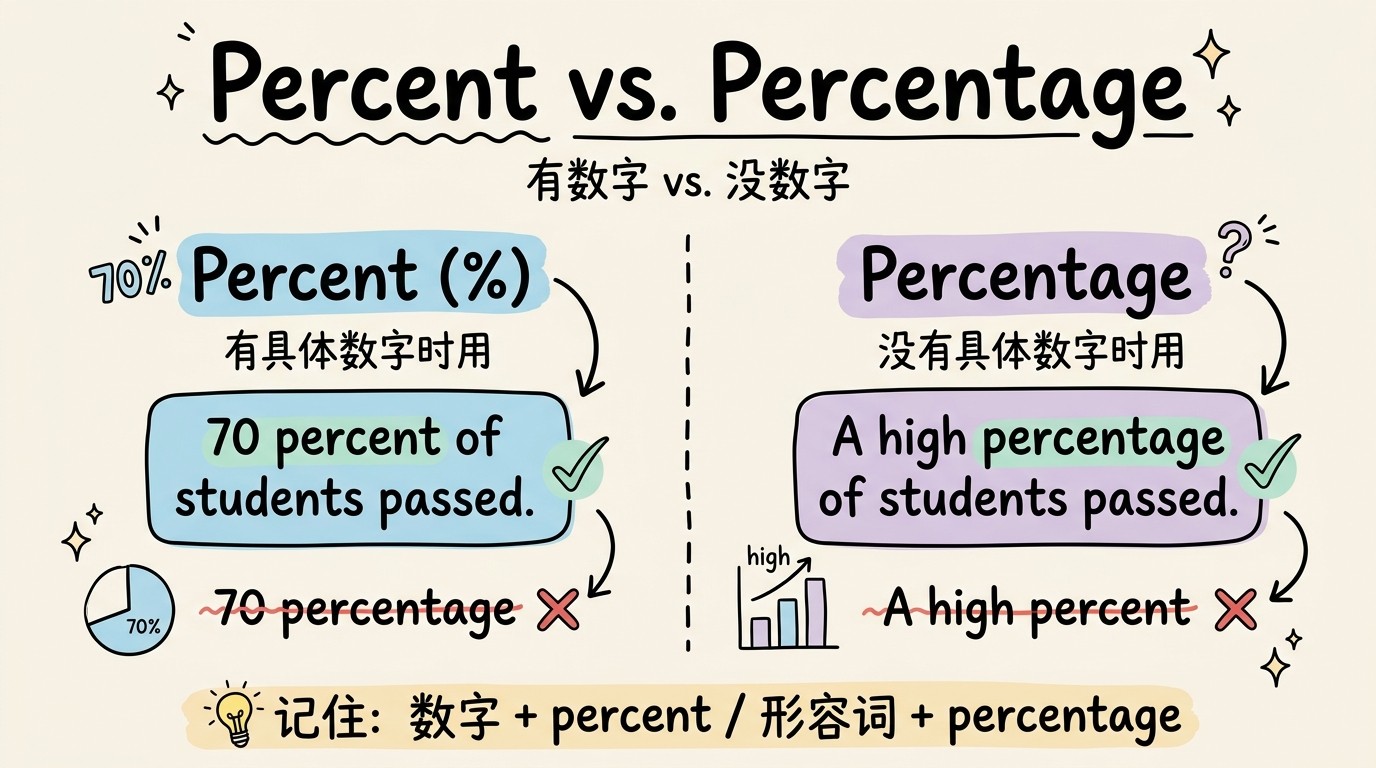
▲ percent vs. percentage 核心区别一图看懂:有数字用 percent,没数字用 percentage
📖 定义简单来说,percent 是跟在具体数字后面表示"百分之几"的词(如 70 percent),而 percentage 是不跟数字、表示"比例"这个抽象概念的词(如 a high percentage)。两者最关键的区别就是:有没有具体数字。
✅ 正确70 percent of students passed.(70%的学生通过了。) 有具体数字70,所以用 percent。
✅ 正确A high percentage of students passed.(大部分学生通过了。) 没有具体数字,只知道比例高,所以用 percentage。
❌ 错误70 percentage of students(错!数字后面必须跟 percent) A high percent of students(错!没有具体数字时,不要用 percent) 70 percents of students(错!percent 永远没有复数形式,不管数字多大都不加 -s)
📐 语法percentage 的主谓一致陷阱:percentage of + 名词 后面的动词单复数取决于 of 后面的名词,而不是 percentage 本身。
✅ A large percentage of students are absent.(students 是复数 → 用 are)
✅ A large percentage of the water is polluted.(water 是不可数 → 用 is) 这条规则在雅思写作和考研英语中经常考到。
by + 差值 = 变化了多少(净变化量);to + 终点值 = 变化到了多少(新数值)——描述增长或下降时,介词选错会让意思完全相反,差之毫厘,失之千里!
📖 定义在英语中,increased by 15% 表示在原有基础上增长了15%的幅度,而 increased to 15% 表示最终数值变成了15%。例如原来是40%,increased by 50% 结果是60%,而 increased to 50% 结果是50%——一个介词之差,数字完全不同。
by 幅度Sales increased by 15%.(销量增长了15%——从原来的基数上多了15%。)
The price fell by 10%.(价格下跌了10%。)
to 终点The pass rate rose to 80%.(通过率上升到了80%——原来可能是60%,现在80%。)
The unemployment rate dropped to 5%.(失业率降到了5%。)
⚠️ 关键问自己:"我想强调变化幅度(by)?还是强调最终结果(to)?"
"increased to 50%" = 原来40%,现在50%(终点是50%)
"increased by 50%" = 原来40%,现在60%(多了50%的幅度) 一个介词之差,数字差了整整10个百分点!
📝
语法解析:为什么是 a 10% increase 而不是 a 10% of increase?
10% 在这里起形容词的作用,直接修饰名词 increase——就像说"a big increase"一样,10% 相当于 big 这个形容词,不需要加 of。
✅ 正确a 10% increase = 一次百分之十的增长(10%像形容词一样描述增长的大小) an increase of 10% = 同样正确,只是结构不同(of 10%作为后置定语)
❌ 错误a 10% of increase —— 语法上完全错误! 因为"of"会强行把"10%"变成所属关系,导致后面缺少宾语。
💡 类比我们说 "a big increase",不说"a big of increase"。
同样,"10%"就相当于"big"这个形容词,直接放在名词前面修饰即可。
🛒
折扣表达:50% off 才是真正的"打五折"
off 直接表示"削掉的幅度"——50% off = 半价(原价100,现价50),因为砍掉了50%的价格。千万别反向理解!
📖 定义英语中 50% off 表示在原价基础上减去50%,即半价(打五折);20% off 相当于中文的"打八折"(原价100,现价80)。off 后面的数字是"减掉的比例",而不是"剩余的比例",这是中文母语者最容易搞反的地方。
折扣50% off = 半价(打五折)——原价100,现价50 20% off = 八折——原价100,现价80 30% off = 七折——原价100,现价70
例句"Everything in the store is 30% off today."
(今天店里所有商品打七折。)
📌 注意在英美购物网站看到 "up to 70% off",意思是"最高降价70%"——也就是三折起。 千万别反向理解成"打七折"!
更多"Take an extra 15% off with this code."
(使用此优惠码可额外享受八五折。)
📐 正式度50% off vs. a 50% discount:两者意思相同,但使用场景不同。% off 更口语化,常见于零售促销、购物网站和日常对话(如 Everything is 30% off);a % discount 更正式,常见于商务合同、报价单和书面沟通(如 We can offer a 15% discount on bulk orders)。日常购物用 off,商务谈判用 discount。
📐
进阶技巧:percent vs. percentage point(百分点)
percent 表示比例本身;percentage point 表示两个百分数之间的算术差值——这是一个非常实用却容易被忽视的区别,专业语境中必须区分清楚。
A: "So, how did we do this quarter?"(那么,我们这个季度表现怎么样?) B: "Pretty good! Our revenue increased by 25% compared to last quarter."(相当不错!我们的营收比上季度增长了25%。) A: "That's impressive. What about the customer satisfaction rate?"(很不错。客户满意度呢?) B: "It rose to 92%. That's up by 5 percentage points from last quarter."(上升到了92%。比上季度提高了5个百分点。) A: "Great. And the return rate?"(很好。退货率呢?) B: "It dropped to 3%. Only a small percentage of customers returned their orders."(降到了3%。只有很小比例的客户退了货。) A: "By the way, are we still running the promotion?"(对了,我们还在做促销吗?) B: "Yes, everything is 20% off until the end of the month."(是的,月底前所有商品打八折。)
📝 对话中出现的 6 个核心表达:
increased by 25%:用 by 表示增长幅度,强调净变化量
rose to 92%:用 to 表示变化终点,强调最终结果
5 percentage points:百分点,表示两个百分数之间的算术差值
dropped to 3%:用 to 表示下降到的终点值
percentage:没有具体数字时用 percentage 表示抽象比例
20% off:折扣表达,off 表示削掉的幅度,20% off = 八折
🧩 来个小测试,看看你掌握了没有
"60%的学生"应该用哪个词?
A. 60 percentage of students B. 60 percent of students C. A 60 percentage of students
✅ 答案:B(60 percent of students)— 在英语中,当百分比前面有具体数字时(如60%),必须使用 percent(60 percent of students),而 percentage 只用于没有具体数字的抽象表达(如 a large percentage)。
"一个很小的百分比"应该怎么说?
A. a small percent B. a small percentage C. a small percent of
✅ 答案:B(a small percentage)— 当没有具体数字、只想表达"一个比例"的抽象概念时,英语中使用 percentage,通常搭配 high / low / small / large 等形容词。
价格从$100降到$80,应该怎么说?
A. decreased by 20% B. decreased to 20% C. decreased by 80%
✅ 答案:A(decreased by 20%)— 价格从$100降到$80,减少了20%的幅度,所以用 by 表示变化量。如果说 decreased to 20%,意思会变成"价格降到了原来的20%",即只剩$20,完全不同。
失业率从8%降到6%,是下降了多少?
A. 2 percent B. 2 percentage points C. 25 percent
Happy learning, and may your percentages always be accurate! 📊
📌 常见问题快速解答
percent 和 percentage 有什么区别?
percent 和 percentage 的核心区别在于是否跟具体数字:percent 用于具体数字之后(如 70 percent of students),而 percentage 用于没有具体数字、只表达抽象比例的场景(如 a high percentage of students)。百分号 % 在英语中读作 percent。常见错误包括 70 percentage of students(应为 70 percent)和 a high percent of students(应为 a high percentage)。
increased by 和 increased to 有什么区别?
increased by 和 increased to 的区别在于:by 表示变化幅度(净变化量),to 表示变化后的终点值。例如 Sales increased by 15% 表示销量在原有基础上增长了15%,而 The pass rate rose to 80% 表示通过率最终达到了80%。混用这两个介词会导致意思完全不同。
50% off 到底是打几折?打八折英语怎么说?
英语中 50% off 表示在原价基础上减去50%,即半价(打五折)。off 表示削掉的幅度,所以 20% off = 打八折(原价100,现价80),30% off = 打七折。如果想说"打八折",英语应该说 20% off。在购物网站看到 up to 70% off,意思是最高降价70%,即三折起。
percent 和 percentage point(百分点)有什么区别?
percentage point(百分点)表示两个百分比数值之间的绝对差值,而 percent 表示比例本身。例如失业率从4%涨到6%,应说 increased by 2 percentage points(增加了2个百分点),而非 increased by 2 percent(那会是4%×1.02=4.08%,完全不同)。在经济、统计和学术写作中,这个区分至关重要。
a 10% increase 和 an increase of 10% 哪个对?
两个都对。a 10% increase 中 10% 起形容词作用直接修饰 increase;an increase of 10% 用 of 短语作后置定语。但 a 10% of increase 是错误的。
百分号 % 在英语里怎么读?
百分号 % 在英语中永远读作 percent。例:37% 读作 thirty-seven percent,0.5% 读作 zero point five percent。
打八折用英语怎么说?20% off 和 80% off 哪个是打八折?
打八折用英语说是 20% off,而不是 80% off。英语中 off 表示"减掉的比例",20% off 意思是减掉原价的20%,剩余80%,即打八折。80% off 则表示减掉原价的80%,只剩20%,相当于打二折。
英语报告中怎么说增长了百分之多少?
在英语商务报告和学术写作中,表达增长幅度用 increased / grew / rose + by + 百分比(如 Our revenue grew by 25% last quarter),表达达到某个水平用 increased / rose + to + 百分比(如 The satisfaction rate rose to 92%)。描述模糊比例时用 a significant percentage of …,描述具体数字时用 X percent of …。这些句式在雅思小作文(IELTS Writing Task 1)描述图表数据时同样适用。
percent 有复数形式吗?能说 percents 吗?
不能。percent 在英语中永远没有复数形式,无论前面的数字多大,都写作 percent 而非 percents。正确写法:70 percent of students,错误写法:70 percents of students。这是中国英语学习者极高频的拼写错误。
percentage of 后面的动词用单数还是复数?
percentage of + 名词 后面的动词单复数取决于 of 后面的名词,而不是 percentage 本身。如果 of 后面是复数名词,动词用复数:A large percentage of students are absent;如果 of 后面是不可数名词,动词用单数:A large percentage of the water is polluted。这条主谓一致规则在雅思写作和考研英语中经常考到。
50% off 和 a 50% discount 有什么区别?
两者意思相同,都表示半价,但使用场景不同。50% off 更口语化,常见于零售促销和日常对话;a 50% discount 更正式,常见于商务合同和书面沟通。日常购物说 off,商务谈判说 discount。
⚠️ 中国英语学习者最常犯的 5 个百分比错误
以下是中文母语者在使用英语百分比表达时最容易踩的坑,对照自查一下:
❶ 把 percentage 用在具体数字后面 ❌70 percentage of students passed. ✅ 70 percent of students passed.(有具体数字时必须用 percent)
❷ 混淆 by 和 to,导致意思完全相反 ❌ 想说"增长了5%"却写成 increased to 5%(意思变成"变成了5%") ✅ increased by 5%(增长了5%的幅度)
❸ 把"打八折"说成 80% off ❌80% off(这是打二折,只剩原价的20%!) ✅20% off(减掉20%,剩余80%,才是打八折)
❹ 用 percent 代替 percentage point ❌ 失业率从4%到6%,说 increased by 2 percent(那是4%×1.02=4.08%) ✅ increased by 2 percentage points(增加了2个百分点)
❺ 百分比修饰名词时多加 of ❌a 10% of increase(语法错误) ✅a 10% increase 或 an increase of 10%(10%起形容词作用,直接修饰名词)